






The views expressed are those of the individual healthcare providers based on their own experience and do not necessarily reflect the views of TAS Medical. Individual experiences may vary. The statements are not intended to represent clinical evidence or guarantee any particular outcome.

Page References
1. Klinge, U., U. Binnebösel, R. Rosch, and P. R. Mertens. “Hernia Recurrence as a Problem of Biology and Collagen.” Journal of Minimal Access Surgery, vol. 2, no. 3, 2006, pp. 151–154.
2. Jansen, P. L., P. R. Mertens, U. Klinge, and V. Schumpelick. “The Biology of Hernia Formation.” Surgery, vol. 136, no. 1, 2004, pp. 1–4.
3. Luijendijk, R. W., W. C. J. Hop, M. P. van den Tol .“A Comparison of Suture Repair with Mesh Repair for Incisional Hernia.” New England Journal of Medicine, vol. 343, no. 6, 2000, pp. 392–398.
4. Muysoms, F. E., S. A. Antoniou, K. Bury. “European Hernia Society Guidelines on the Closure of Abdominal Wall Incisions.” Hernia, vol. 19, no. 1, 2015, pp. 1–24.
5. Holihan, J. L., D. H. Nguyen, J. R. Flores-Gonzalez. “A Systematic Review of Randomized Controlled Trials and Reviews in the Management of Ventral Hernias.” Journal of Surgical Research, vol. 204, no. 2, 2016, pp. 311–318.
6. Holihan, J. L., E. P. Askenasy, J. A. Greenberg. “Mesh Location in Open Ventral Hernia Repair: A Systematic Review and Network Meta-Analysis.” World Journal of Surgery, vol. 40, no. 1, 2016, pp. 89–99.
7. Janis, J. E. “Clinically Applied Biomechanics of Mesh-Reinforced Ventral Hernia Repair: A Practical Review.” Plastic and Reconstructive Surgery—Global Open, 2024.
8. “Data on File”
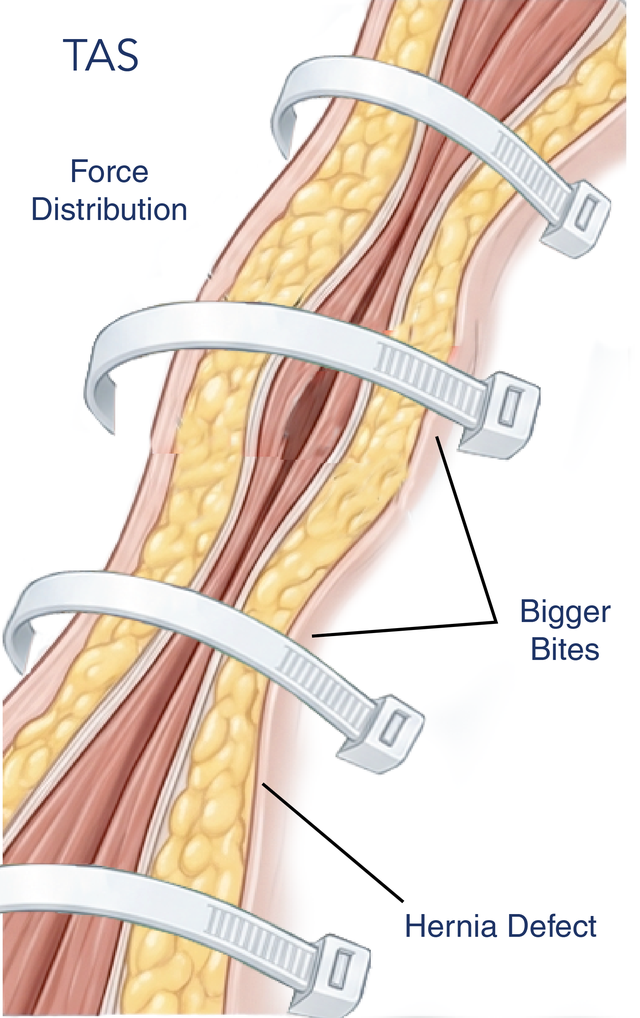
The Tissue Approximation System (TAS) consists of polyamide (nylon) non-absorbable zip-ties attached to braided polyethylene terephthalate (PET, or Dacron) suture leaders to aid insertion. Suture leaders have various ends including loops and plain, cut ends. Instruments may include suture passer(s), a blunt dissector, a needle, and knot pusher(s)/cutter(s). The zip-tie is a non-USP suture because it is secured using a clasp instead of a knot and its diameter is not within the USP designated sizes. The closest USP size for which our device has met knot-pull tensile test requirements is size 7.
The Tissue Approximation System (TAS) is indicated for use in soft tissue approximation, including use in general surgery procedures such as minimally invasive ventral hernia and abdominal wall closure less than 10cm, but not for use in ophthalmic, neurologic, or cardiovascular procedures.
The Tissue Approximation System (TAS) is intended for single-patient, single-use only. Do not reuse, reprocess, or resterilize the device. Use only if the packaging is intact and the device has not passed its expiration date.
Do not use the TAS in patients with a known allergy to nylon (polyamide), where permanent tensile strength is required, or for epidermal (surface) skin closure. The device should not be used in ischemic or necrotic tissue.
As with all suture-based wound closure devices, potential complications may include infection, erythema, foreign body reaction, transient inflammation, seroma formation, and, in rare cases, wound dehiscence. Appropriate patient selection, surgical technique, and the use of an adequate number of devices are important to support optimal wound healing.
Caution: Federal (U.S.) law restricts this device to sale by or on the order of a licensed healthcare practitioner. Please refer to the Instructions for Use for complete indications, contraindications, warnings, precautions, and instructions for use.